
 By dbtuser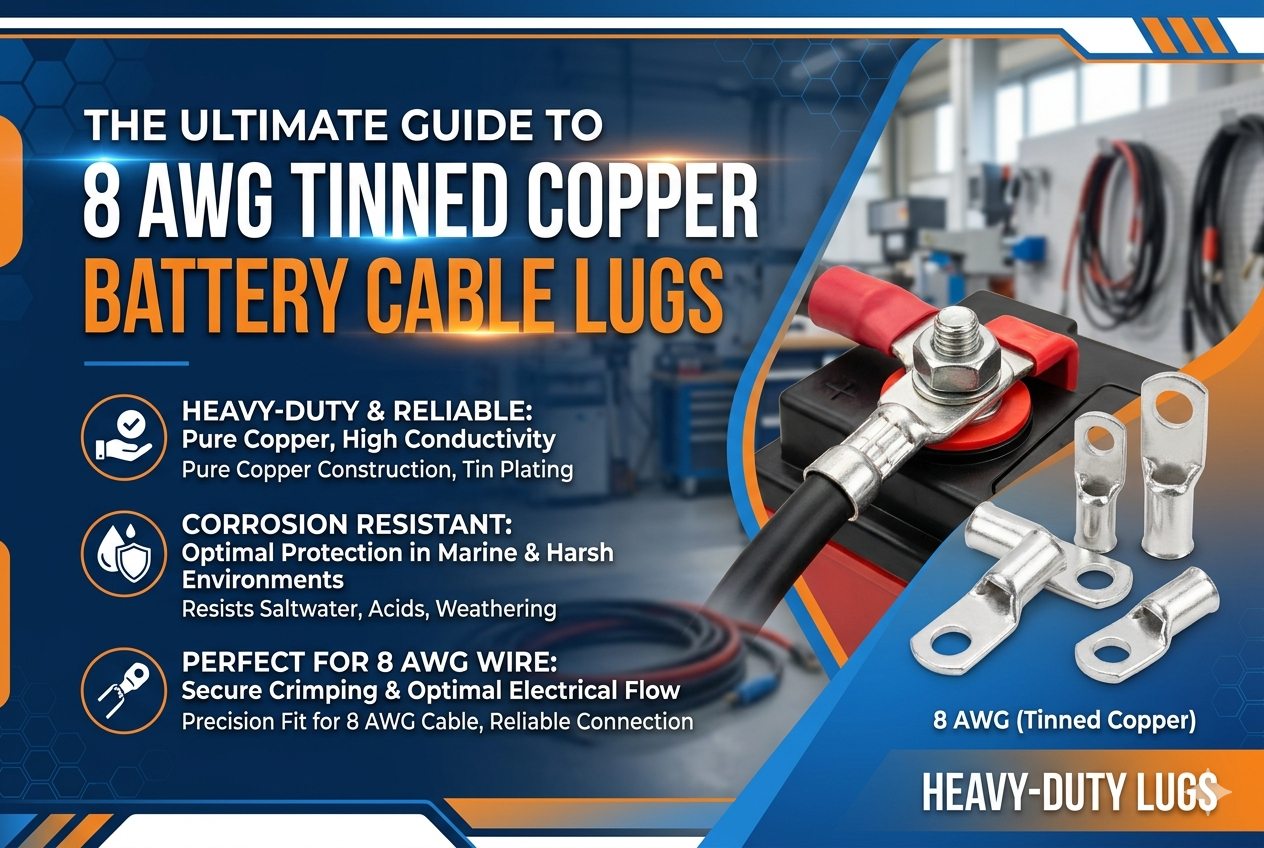
When building or upgrading an electrical system, the spotlight often falls on the major components: high-capacity batteries, robust power inverters, or heavy-duty marine alternators. However, the integrity of any electrical circuit is only as strong as its weakest point. In high-current applications, that point is frequently the termination interface. For medium-duty power distribution, automotive wiring, solar arrays, and marine environments, 8 AWG tinned copper battery cable lugs with ring terminals represent the industry standard for securing efficient, safe, and corrosion-resistant connections.
Understanding the engineering behind an 8 awg tinned lug, selecting the correct specifications, and mastering the installation process is critical to preventing voltage drops, equipment failure, and potential electrical fires.
The Anatomy of an 8 AWG Tinned Copper Lug
An electrical lug is more than just a piece of stamped metal; it is an engineered component designed to facilitate maximum current transfer with minimal resistance.
Pure Copper Core
The foundation of a high-quality 8 gauge tinned copper lugs is high-conductivity, seamless structural copper (often conforming to ASTM standards). Copper is selected for its exceptional electrical conductivity, surpassed only by silver. Using seamless tubular copper ensures that the barrel of the lug will not split or crack under the immense pressure of a hydraulic or mechanical crimping tool.
Electro-Tin Plating
While raw copper offers excellent conductivity, it is highly susceptible to environmental degradation. When exposed to oxygen, moisture, and heat, copper oxidizes, forming a layer of copper oxide. This oxidation acts as an electrical insulator, drastically increasing resistance at the joint.
To combat this, the copper is electro-plated with a precise layer of tin. Tin is highly resistant to corrosion and tarnish. By protecting the underlying copper from the atmosphere, tinning ensures that the lug maintains its low resistance over years of service, even in harsh or humid conditions.
Closed-End Design
Premium battery lugs feature a solid, closed-end barrel structure. This design element ensures that moisture, automotive fluids, or marine salt spray cannot creep up into the stranded copper wire from the terminal side. It also prevents solder from leaking out if a solder-dip installation method is used.
Why 8 AWG Matters: Current Capacity and Matching
The American Wire Gauge (AWG) system measures the cross-sectional area of a conductor. An 8 AWG wire is approximately $3.26\text{ mm}$ in diameter. Choosing an 8 awg tinned lug means matching the inner barrel diameter precisely to this wire size.
Using a lug that is too large results in a loose crimp, poor mechanical strength, and severe electrical resistance. Conversely, forcing an 8 gauge wire into a smaller lug requires trimming back copper strands, which reduces the current-carrying capacity of the wire and creates a dangerous bottleneck.
In typical 12V or 24V DC systems, an 8 AWG conductor is generally rated to safely carry continuous currents between 50 to 70 Amperes, depending on the temperature rating of the wire insulation (e.g., $75^\circ\text{C}$ vs. $105^\circ\text{C}$) and the length of the cable run. This makes it the ideal gauge for:
- Trolling motors and small outboard marine engines
- Custom automotive audio amplifiers and dual-battery setups
- Mid-sized solar panel array combiners and charge controllers
- Power inverter DC input lines for smaller appliances
Selecting the Right Ring Terminal Size
The “ring terminal” portion of the lug connects directly to a threaded stud or terminal post. While the barrel side must always match the 8 AWG wire size, the ring eyelet must match the stud diameter. 8 gauge tinned copper lugs are commonly manufactured with a variety of hole sizes to accommodate standard electrical studs:
| Stud Size (US) | Metric Equivalent | Common Application |
|---|---|---|
| #10 | M5 | Barrier strips, small distribution blocks, grounding screws |
| 1/4 in | M6 | Compact marine batteries, solar charge controllers, small busbars |
| 5/16 in | M8 | Standard automotive battery terminals, heavy-duty busbars, winches |
| 3/8 in | M10 | Large deep-cycle marine batteries, high-output inverter terminals |
Selecting the exact match prevents the lug from shifting under vibration, ensuring maximum surface area contact between the lug pad and the terminal pad.
Best Practices for Installation: Crimping vs. Soldering
To achieve a gas-tight, permanent connection, proper installation technique is non-negotiable. There are two primary methods for securing an 8 awg tinned lug to a cable: crimping and soldering.
1. Mechanical Crimping (Recommended)
Crimping relies on extreme mechanical force to cold-weld the copper strands of the wire to the inner wall of the tinned copper lug. For an 8 AWG connection, a heavy-duty lever-operated crimper or a specialized hammer-blow crimping tool is highly recommended over standard hand-held pliers.
- Strip the Wire: Carefully remove just enough insulation so the bare copper strands completely fill the lug barrel, leaving a negligible gap (less than $1\text{ mm}$) between the insulation and the lug.
- Insert and Crimp: Push the wire firmly into the barrel. Place the lug in the appropriate 8 AWG die of the crimping tool and execute the crimp. A perfect crimp deforms the metal uniformly without leaving sharp, over-extruded “ears” on the sides.
2. Soldering
Soldering fills the voids between the wire strands and the lug barrel with a molten alloy. While highly conductive, soldered joints can become brittle over time. In high-vibration environments like vehicles or boats, a soldered wire is prone to fracturing right at the point where the solder stops and the flexible wire begins. If soldering is chosen, it should always be accompanied by robust mechanical strain relief.
3. Environmental Sealing
No matter which method is used, always finish the termination with premium adhesive-lined dual-wall heat shrink tubing. Slide the tubing over the joint and apply heat until it shrinks tightly around the cable insulation and the lug barrel. The inner adhesive melts and flows into any micro-gaps, creating a completely watertight barrier that seals out oxygen and moisture, maximizing the lifespan of your connection.
Conclusion
Investing in high-quality 8 gauge tinned copper lugs is a small but critical decision that pays massive dividends in system reliability, safety, and performance. By selecting seamless copper components with superior electro-tin plating, matching the ring eyelet precisely to your terminal studs, and utilizing proper crimping and sealing techniques, you eliminate weak points in your electrical grid. Whether traversing choppy waters in a marine vessel or managing a remote off-grid solar installation, these heavy-duty connectors provide the peace of mind that your power flows uninterrupted.